
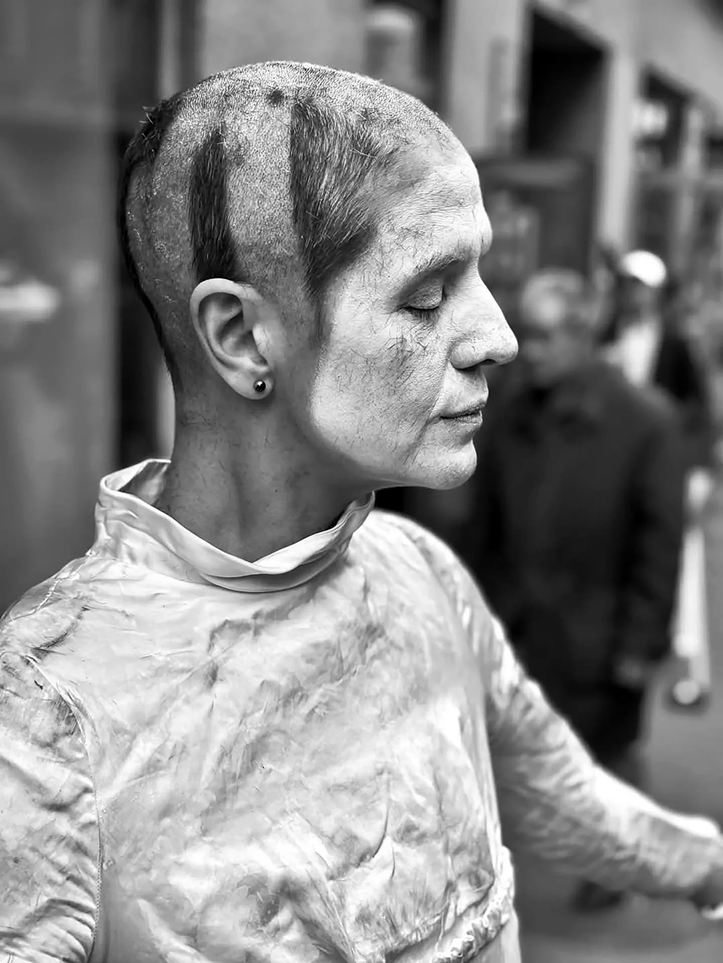
photo by Mark Maher
IN ENGLISH
Josef Ka | FORMAT
8–10 минут
In 2022, in parallel with documenta 15, the German-Chinese curator Qing Cai organized an international live art art festival Overlapping Kassel at Kassel. Josef Ka, an international performing, visual and sound artist, appeared in the second part of this festival. Because we both stayed overnight at the place at Lake Buga, one beautiful sunny morning, about six o’clock in the morning, we met at the front door of our residence. Josef Ka stood dressed in a black costume, holding a bottle of champagne. She offered me a sip of liquor from the bottle. “For breakfast?” I asked. “La Boheme,” she replied. The artist, wanting to use the early bright light, waited for a photo session prepared for her by the excellent Hungarian photographer and performer Istvan Kovac. In the green meadow, just in front of the building, she performed Funny fun during the war (spectacle for geese).
In the public space, Kassel, as well as in the Moving School room cooperating with our festival, presented an action with anti-war pronunciation. She played pathetically, took on lofty, sometimes dramatic poses. Throughout the festival, she walked in a costume. It was a red-stained paint, a long white canvas shirt. She braided her head with a bandage. In this way, she transformed her performance into a continuous artistic event.
In 2023, I invited Josef Ka to participate in the second edition of the Women’s World festival organized by me. It was held in the Pandora gallery in Kreuzberg, Berlin. She presented the fourty-minute work I am Edith Södergan, dedicated to the St. Petersburg-born Finnish poet and feminist Edith Södergan. The poet’s expressionist work has influenced a whole generation of Finnish and Swedish writers. Josef Ka received a grant from the Nordic-Baltic Mobility Programme for Culture. She abstractly brilliantly captured the spirit of the modernist work of a great Scandinavian figure, showing the extraordinary ability to build scenes.
She has participated in the Women’s World festival four times. Three times in Berlin and once in Poznań, where she presented American Gothic video performances during her stay in the United States. The work was an allusion to the iconic painting by the American painter Grant Wood, who caused the American rebellion with this work. A very successful video showed the way she works: Josef Ka eagerly refers to the iconography of slogans and slogans, uses costume and make-up, and her face paints with white paint. He often uses audio and video projection. In performances, both outdoors outdoorand inside (indoor) embraces the whole space, walks, dances, lays down. He creates long narratives and can keep viewers in tension. “The costume is part of the ritual – a layer of meanings that connect the body, space and intention. I never see it as a decoration; it’s a vivid extension of the concept, the skin changing with the place and the moment. Sometimes he protects, sometimes he reveals. It helps me to enter a state in which the body becomes both an image and a tool – open to what I want to show.”
I admired her for organizing, internal discipline and devotion to art. I have observed her artistic activity in various European countries. In 2023, despite her knee injury, she did not give up performing in Belgium and Sicily. She was driving across Europe to present her show in the south of Italy. “Yes, this journey was long and the pain was real. But pain is always part of my process. I’m not running away from him. I’m trying to listen to him. Discipline for me is not control. To be ready means to remain open, even when the body resists. Art is not waiting for comfort. The scene, the street, the bus – all places become part of the same ritual.” Josef Ka is a type of wandering performer. It is spreading energy and the desire to create. The performance became a passion for her. Marina Abramović said that the need to be an artist is like a need to breathe. You just have to breathe to live, and you have to make art to live. I see similarities between these two artists.
Josef Ka is an artist of Russian origin, living and working in Helsinki, Finland. In 2024 she stayed at an artistic residence in Vienna. Not only did she get to know the artistic environment of the city, but she also received the opportunity to present her own works. She has been associated with the Hermann Nitsch Foundation and the Mysterien Theater Foundation for years. In 2024, she was invited by Rita Nitsch to participate in the Pfingstfest 2024 event in Prinzendorf, where she presented the performance of Ascension in cooperation with composer Franciszek Araszkiewicz (music) and Lena Perelman (light). In the action dedicated to Hermann Nitsch, Josef Ka was sensationally portrayed by an extremely tormented, painful, bodily creature. Strong and historical speeches of the Vienna shareholders clearly seduced and influenced the artist.
In 2025 in Warsaw in the Lotna gallery she showed a performance dedicated to Günter Brus. “Brus turned his body into a medium of truth. I admire his honesty and courage. In Brus’s play, it was never about shock, but about confrontation – about exposing human form, about bringing it to the most fragile and significant state. When I was in Warsaw, I wanted to continue this dialogue – not through imitation, but through a story. I have honored the courage needed to reveal internal wounds without apology.”
One of Brus’s most famous performances is the 1965 Vienna Walk. The artist walked around Heldenplatz in a suit painted white with emulsion paint, with a black line in the middle running from head to toe. The line started with the right foot, running through the jacket, neck, mouth, nose and top of the head, and ended at the back of the torso on the left heel. Brus depicted a walking sculpture. He protested against the authoritarian state. Unfortunately, in a short time he was arrested and fined for disorderly conduct. He became famous as a pioneer of artistic figures in contemporary art. It has broadened social tolerance in Europe and influenced generations of artists. In the first decade of the 21st century, art figures such as Eva and Adele, Garyson Perry, Alexandra Fly provoked public opinion without consequences from the authorities.
“In 2025, it is the 60th anniversary of the creation of the Günter Brus Walk in Vienna. Throughout the year, I repeat this legendary action in every city and landscape I encounter. Each walk is both a tribute and a transformation, extending Brus’s radical gesture to new geographical areas and new times.”
I asked Josef Ka about the current audience reactions both in Vienna and in other countries. “On the streets of Vienna, the first reaction was curiosity – it’s the quiet tension between fascination and anxiety. People would look, follow me, sometimes smile, sometimes turn around. It reminded me of Brus’s walks – how public space can become a mirror of the collective consciousness. Apart from Vienna, the reactions were different, but they had the same pulse: a mixture of delight and distance.”
Josef Ka is a performer, visual artist, curator, butoh dancer. She is the founder of the Sauna gallery in Helsinki, where she cyclically presents international video editions of the performance. As a traveling performer, she is found in many European countries. But he prefers to return to Vienna. She surrendered her life to art. When asked what art means to her, she replied: “Art is not something I do – it’s the language I live in. It shapes my days, my relationships and even my pain. Without it, I would have been silent. In Vienna, I always feel the presence of ghosts – Nitsch, Brus, Muehl, Schwarzkogler – artists who turned the body into testimony. The audience there understands this tradition. They don’t look for entertainment, they look for the truth, the intensity. Their reactions are often quiet, full of reverence. In this silence, I feel connection and continuity.”
Text: Alexandra Holownia
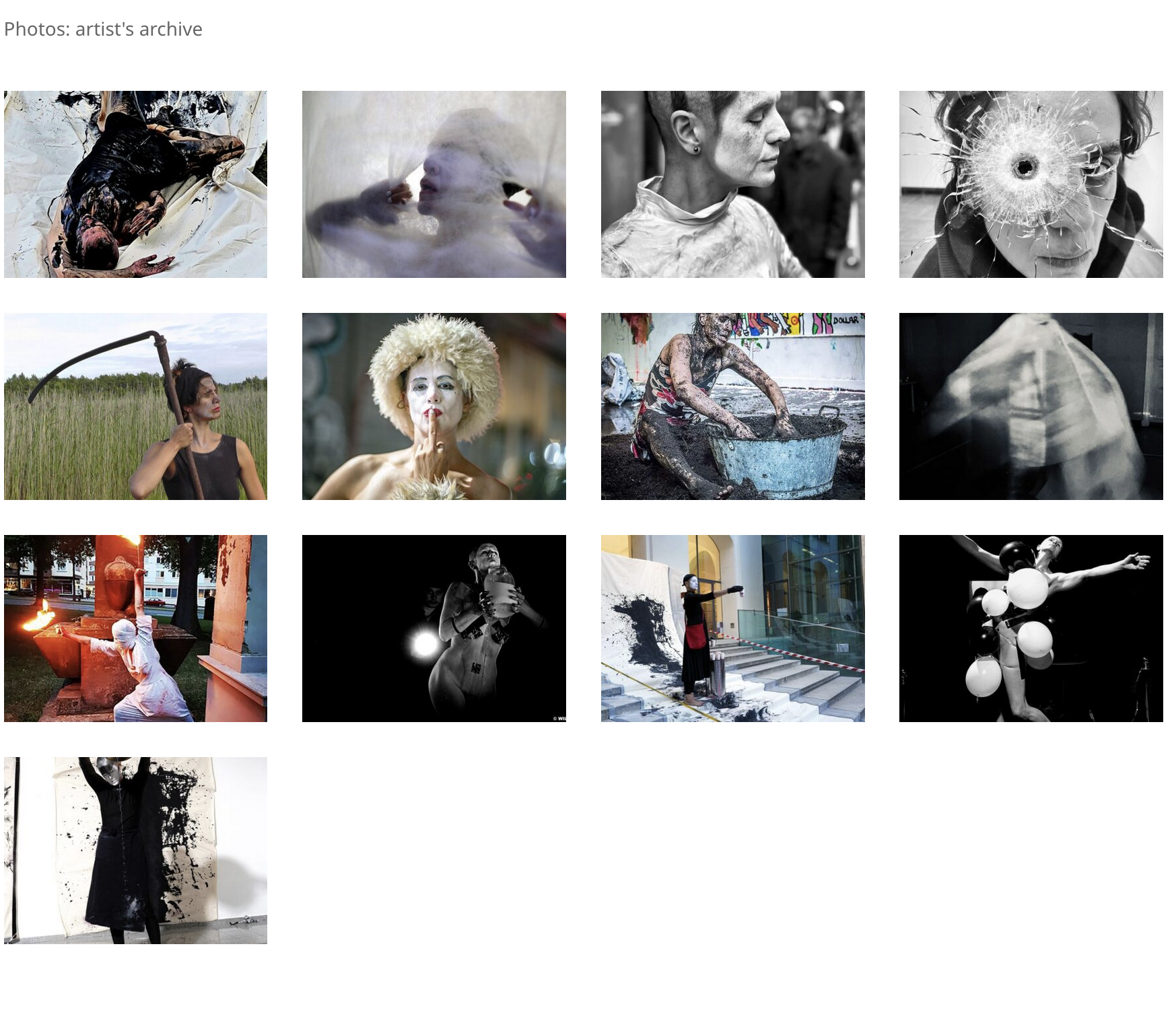
photos by Mark Maher, Walter Ulreich, Antti Ahonen, Peter Baren, Sandra Wilk, Marcel Plavec, Wei Chao, Julio Marin Alvarez
 JOSEF KA